
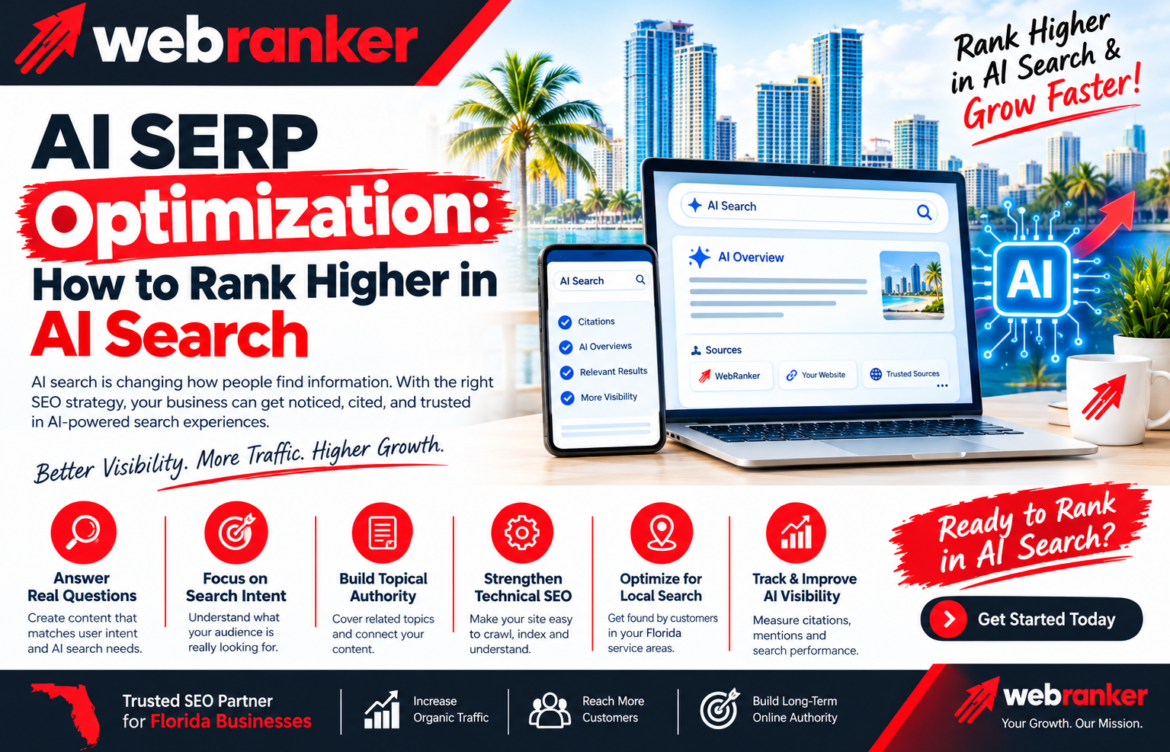
AI SERP Optimization: How to Rank Higher in AI Search
Search is changing rapidly. People are no longer relying only on traditional search engine result pages to find information, compare services, or make purchasing decisions. AI-powered search experiences can now summarize information, answer questions conversationally, compare options, and provide links to supporting sources.
For businesses, this creates a new opportunity: AI SERP optimization.
Traditional SEO remains important, but businesses also need to consider how their content can be understood, retrieved, summarized, and cited by AI-powered search systems. Google stated in its 2026 Search documentation updates that SEO best practices continue to be relevant for its generative AI search features.
At the same time, Microsoft Bing has introduced AI Performance reporting that helps publishers see when their pages are cited in AI-generated answers and which URLs are referenced.
This means businesses should think beyond simply ranking for keywords. The goal is to create clear, useful, technically accessible, trustworthy, and well-structured content that can serve both traditional search users and emerging AI search experiences.
For businesses looking for SEO Services in Florida, understanding these changes can help create a more future-ready search strategy.
What Is AI SERP Optimization?
AI SERP optimization is the process of improving website content and technical SEO so that information is easier for search engines and AI-powered systems to understand and potentially surface in generated answers.
Traditional SEO often focuses on:
- Keyword rankings
- Organic traffic
- Search visibility
- Click-through rates
- Backlinks
- Technical performance
AI search adds additional considerations, such as:
- Whether content clearly answers a question
- Whether information can be easily extracted and understood
- Whether a page provides trustworthy supporting evidence
- Whether the website demonstrates relevant expertise
- Whether content covers a topic comprehensively
- Whether pages are technically accessible to search systems
- Whether a website becomes a useful source for AI-generated answers
Microsoft describes this broader development through concepts such as grounding and Generative Engine Optimization (GEO), where AI systems use web information to generate answers and provide citations.
AI SERP optimization should therefore be viewed as an extension of strong SEO rather than a completely separate replacement for traditional search optimization.
Why AI Search Matters for Businesses
AI-powered search changes the way users interact with information.
Instead of searching:
“SEO agency Florida”
a potential customer may ask:
“What should a small business in Florida look for when choosing an SEO agency?”
Or:
“How can I improve my Google rankings and get more local customers?”
These longer, conversational searches require content that addresses questions, intent, context, and related topics.
AI systems may also combine information from multiple sources when generating an answer. Bing’s AI Performance tools, for example, allow website owners to observe citations and grounding queries associated with AI-generated answers.
For businesses, this means visibility can involve more than appearing as a traditional blue-link result.
Traditional SEO Still Matters in AI Search
One of the biggest misconceptions about AI search is that traditional SEO no longer matters.
It does.
Google’s June 2026 documentation update specifically clarified that SEO best practices continue to be relevant to success in generative AI features in Google Search.
That means businesses should continue investing in:
- Crawlability
- Indexing
- Technical SEO
- Quality content
- Search intent
- Internal linking
- Structured data where appropriate
- Page experience
- Local SEO
- Authoritative references
- Website architecture
AI search does not eliminate the fundamentals of search optimization. Instead, it adds another layer to the way content can be discovered and used.
1. Create Content That Directly Answers Questions
One of the most practical AI SEO strategies is to answer important questions clearly.
Instead of writing long introductions before addressing the topic, provide the answer early.
For example, if your page targets SEO Services in Florida, you could answer:
What are SEO Services in Florida?
SEO Services in Florida help businesses improve their organic search visibility through strategies such as keyword research, technical SEO, content optimization, local SEO, website improvements, and performance monitoring.
After providing the direct answer, you can explain the topic in greater detail.
This structure helps users quickly understand the subject while creating clearly organized information for search systems.
2. Understand Search Intent
Keywords are still important, but understanding why someone searches is equally important.
Search intent can generally include:
- Informational intent
- Commercial investigation
- Transactional intent
- Navigational intent
- Local intent
For example:
“What is technical SEO?”
This is primarily informational.
“SEO Services in Florida”
This may have commercial or local intent.
“Best SEO agency near Tampa”
This combines commercial and local intent.
Your content should match the purpose behind the search.
If users are looking for an explanation, provide an explanation. If they are comparing services, provide useful comparison information. If they are looking for a local provider, make your location and service information clear.
3. Build Strong Topical Coverage
AI systems can evaluate information across concepts and related topics rather than relying only on one exact keyword.
This makes topical authority increasingly important.
For example, a website targeting SEO Services in Florida could create related content covering:
- Technical SEO
- Local SEO
- Google Business Profile optimization
- Keyword research
- On-page SEO
- Content marketing
- Link building
- SEO audits
- Website speed
- Search intent
- Conversion optimization
- AI search optimization
These topics can then be connected through internal links.
The result is a website that provides broader coverage instead of relying on one page repeatedly targeting the same keyword.
Microsoft’s 2026 AI visibility reporting also introduced Topics, which groups related grounding queries into broader thematic clusters.
4. Make Your Content Easy to Understand
AI search optimization does not mean writing content specifically for machines.
Your primary audience should remain human readers.
Use:
- Short paragraphs
- Clear headings
- Descriptive subheadings
- Bullet points
- Tables when useful
- Definitions
- Examples
- Step-by-step explanations
- FAQs
Avoid unnecessary jargon and overly complicated sentences.
A clearly structured article makes it easier for visitors to scan and understand the information.
It can also make important information easier for search systems to interpret.
5. Demonstrate Experience and Expertise
Businesses should explain why readers should trust their information.
Depending on the subject, this can include:
- Author information
- Business experience
- Case studies
- Original research
- Examples
- Data
- References
- Industry knowledge
- Clearly explained processes
- Accurate business information
For commercial pages, explain what the business actually provides.
For informational content, support important claims with reliable sources where appropriate.
The objective is not to add impressive-sounding language. It is to provide information that is useful, specific, and supported by evidence.
6. Strengthen Technical SEO
Strong content cannot perform properly if search engines have difficulty accessing or understanding the website.
Technical SEO should include regular checks for:
- Crawlability
- Indexing
- Broken links
- Redirects
- Canonical URLs
- XML sitemaps
- Mobile usability
- Page speed
- HTTPS
- Duplicate content
- Internal linking
- JavaScript-related accessibility issues
A technical SEO audit can identify problems that may prevent important pages from being properly discovered or indexed.
This is one reason technical SEO remains an important part of professional SEO Services in Florida.
7. Use Structured Data Where Appropriate
Structured data provides machine-readable information about page content.
Depending on the website, relevant structured data may help search engines better understand things such as:
- Organizations
- Businesses
- Products
- Articles
- Events
- Reviews
- Services
- Breadcrumbs
Structured data should accurately represent the visible content on the page and follow the relevant search-engine guidelines.
It should not be treated as a shortcut for rankings.
Instead, think of structured data as a way of improving how your website communicates information to search engines.
8. Build a Strong Internal Linking Structure
Internal links connect related pages on your website.
For example, an SEO website could connect:
SEO Services in Florida → Technical SEO → Local SEO → SEO Audit → Content Optimization
This helps users discover related information and gives search engines additional context about the relationship between pages.
Use descriptive anchor text rather than repeatedly using generic phrases such as “click here.”
A strong internal linking structure can also help distribute authority throughout the website and make important pages easier to discover.
9. Support Important Claims With Reliable Sources
AI-generated answers often rely on information gathered from multiple sources.
If your article makes an important factual claim, support it with an appropriate source when possible.
Useful sources can include:
- Government websites
- Official documentation
- Research organizations
- Industry organizations
- Primary company documentation
- Original research
- Recognized publications
For example, when discussing Google’s AI search guidance, Google’s own Search Central documentation is a more direct source than an unrelated third-party article.
This approach also helps readers verify information.
10. Keep Important Content Updated
AI search and traditional search both operate in an environment where information changes.
Businesses should periodically review important pages for:
- Outdated statistics
- Old screenshots
- Broken links
- Changed services
- Old pricing
- Outdated regulations
- Incorrect business information
- Old SEO recommendations
Microsoft’s AI Performance guidance specifically highlights keeping content fresh and accurate as one way publishers can improve the usefulness of their content for AI-generated experiences.
Do not update an article simply to change its publication date. Update it when there is meaningful information to improve.
11. Optimize for Local Search
Local SEO is especially important for businesses serving specific geographic areas.
If your company provides SEO Services in Florida, clearly communicate:
- Service areas
- Business location
- Contact information
- Services offered
- Local business details
- Customer questions
- Relevant Florida markets
Maintain consistent business information across important platforms.
Create useful location-specific content rather than producing multiple pages that simply replace the city name.
For example, a Florida SEO company might create genuinely useful resources around local search challenges faced by businesses in different Florida markets.
12. Don’t Ignore Brand Mentions and External Authority
Your website is not the only place where your business can build online visibility.
Relevant external mentions can help establish your business presence across the web.
These may include:
- Industry publications
- Business directories
- Local organizations
- Partner websites
- Professional profiles
- News coverage
- Relevant community websites
The focus should be on relevant and legitimate visibility, not generating large numbers of low-quality links.
Avoid manipulative link-building practices or mass-produced pages designed only to influence rankings.
13. Measure AI Search Visibility
Traditional SEO reporting usually focuses on metrics such as:
- Organic clicks
- Impressions
- Rankings
- CTR
- Conversions
- Organic traffic
AI search introduces additional questions:
- Is your content being cited?
- Which pages are cited?
- Which topics generate citations?
- Which search intents lead to visibility?
- Is citation activity changing over time?
Bing’s AI Performance tools now provide insights into citations, grounding queries, cited pages, intents, topics, and citation share.
These metrics should complement traditional SEO reporting rather than completely replace it.
Common AI SEO Mistakes to Avoid
1. Creating Content Only for AI
Writing unnatural content stuffed with keywords does not create a better user experience.
Write for people first.
2. Publishing Large Amounts of Low-Quality AI Content
Producing hundreds of pages with little original value can create a poor website experience and may introduce duplicate or inaccurate information.
Focus on useful content rather than volume alone.
3. Ignoring Technical SEO
Excellent content cannot compensate for serious crawling, indexing, or accessibility problems.
4. Chasing Every New AI SEO Trend
AI search is evolving quickly. Not every new tactic is a ranking requirement.
For example, Google clarified in June 2026 that llms.txt is not needed for Google Search and does not positively or negatively affect Google Search visibility or rankings.
Focus first on established SEO fundamentals.
5. Forgetting Search Intent
A page can contain the target keyword and still fail to satisfy what the searcher actually wants.
How SEO Services in Florida Can Support AI Search Optimization
Businesses that want to adapt to AI search can integrate AI-focused considerations into their existing SEO strategy.
Professional SEO Services in Florida can include:
Keyword and Intent Research
Identify the questions, topics, and commercial searches relevant to your customers.
Technical SEO
Improve crawling, indexing, website architecture, mobile performance, and technical accessibility.
Content Optimization
Develop useful content that answers customer questions clearly and comprehensively.
Local SEO
Improve visibility for location-based searches and strengthen local business information.
On-Page SEO
Optimize titles, headings, content structure, URLs, internal links, and relevant page elements.
SEO Monitoring
Track organic performance and, where available, emerging AI visibility and citation signals.
How WebRanker Can Help
WebRanker provides digital marketing and SEO solutions designed to help businesses improve their online visibility and reach potential customers.
WebRanker’s SEO approach can include:
- Keyword research
- On-page SEO
- Technical SEO
- Content optimization
- Local SEO
- Link-building strategies
- Google Business Profile optimization
- Website analysis
- SEO performance monitoring
- Search visibility improvement
For businesses targeting customers in Florida, a well-planned SEO strategy can combine traditional search optimization with content practices designed for the evolving AI search environment.
The goal is not simply to chase an AI-generated answer. It is to build a website with useful information, clear structure, strong technical foundations, and relevant authority.
Explore WebRanker’s SEO services to learn more about its digital marketing solutions.
Conclusion
AI SERP optimization is becoming an important consideration as search evolves from traditional lists of links toward more conversational and AI-powered experiences.
However, businesses do not need to abandon traditional SEO.
The strongest foundation remains:
- Helpful content
- Search-intent alignment
- Technical SEO
- Clear website structure
- Internal linking
- Relevant authority
- Accurate information
- Local SEO
- Regular content updates
- Performance measurement
Google’s current guidance indicates that established SEO practices remain relevant to its generative AI search features, while Bing is providing new tools for understanding how websites are cited in AI-generated answers.
For businesses targeting customers in Florida, investing in SEO Services in Florida can therefore involve both traditional organic search optimization and preparation for emerging AI-driven discovery.
The key is to create content that is genuinely useful to people while making your website easy for search engines and AI systems to understand.
Frequently Asked Questions
What is AI SERP optimization?
AI SERP optimization is the process of improving website content, structure, and technical SEO so information can be better understood and potentially surfaced or cited in AI-powered search experiences.
Does traditional SEO still matter for AI search?
Yes. Google has stated that SEO best practices remain relevant for its generative AI search features. Technical accessibility, useful content, search intent, and website structure continue to matter.
How can businesses prepare for AI search?
Businesses can focus on useful content, clear answers, technical SEO, topical coverage, internal linking, trustworthy sources, local SEO, and regular content updates.
What is GEO in SEO?
GEO commonly refers to Generative Engine Optimization, a term used to describe efforts to improve how content participates in AI-generated search experiences. Microsoft has used the term when discussing the changing role of web content in AI-driven experiences.
Can SEO Services in Florida help with AI search visibility?
Yes. SEO services can address technical SEO, content optimization, search intent, local SEO, internal linking, website structure, and performance monitoring—all of which can contribute to a stronger foundation for traditional and AI-powered search visibility.
Does llms.txt improve Google rankings?
Google’s June 2026 guidance says llms.txt is not needed for Google Search and does not have a positive or negative effect on Google Search visibility or rankings.
How can I monitor AI search visibility?
Some platforms are beginning to provide AI-specific visibility data. For example, Bing Webmaster Tools’ AI Performance reporting provides information about citations, cited pages, grounding queries, and related visibility patterns.